
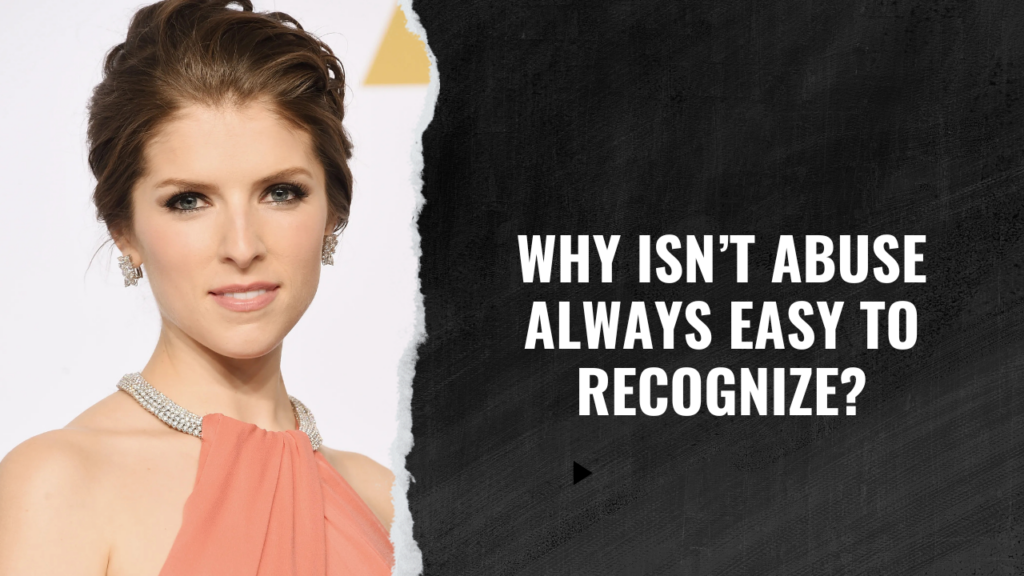
Anna Kendrick went on the Call Her Daddy podcast and discussed an abusive relationship she had endured. She spoke with candor and vulnerability about her experience, pointing out how discussions about red flags can feel like victim blaming, how abuse doesn’t always present in the same way, and how she never thought this would happen to her.
Maddie Hahn, manager of JBWS’ Dating Abuse Prevention program, came on Unsilenced: Real Conversations About Abuse to discuss all aspects of Anna Kendrick’s interview. Watch the episode below or scroll to read more about this topic.
Anna Kendrick says that her relationship didn’t follow the traditional pattern of abuse. So, when she was looking at all these articles trying to figure out if she was being abused, some things fit but others didn’t. Does abuse always present the same way?
Maddie: No, it can be so different. And I think she had a beautiful way of speaking about that. It also speaks to the experience of being in a relationship where there is abuse because she was looking for the signs and trying to read these articles.
She’s trying to see if her experience fits this narrative and at the same time, she’s identifying ways she doesn’t fit that criteria. It speaks to what it feels like to be in an unsafe relationship because even as you’re trying to navigate resources, part of your brain is trying to say, ‘this can’t be me. I don’t fit this mold.’ There’s that sense of denial with abuse that some people don’t want to identify with.
I love what you’re saying because if your relationship doesn’t exactly line up with how we’ve been talking about abuse externally, it doesn’t mean that you’re not experiencing abuse. Why isn’t it always that easy to recognize?
Maddie: There are so many reasons that abuse isn’t easy to recognize. You can be in a relationship for a long time before this happens, or it could happen at the very beginning. This isn’t a situation where it’s black and white. I think relationships really live in that gray area.
Anna talked about this but there can be good things in an abusive relationship, too. People can love the person who is causing them harm. So, that is another kind of shield on our ability to see what’s going on because we often do still like that person.
And it’s almost like you don’t want it to be true. People look for all the ways that it doesn’t fit because it’s difficult to fully accept that abuse is happening. Another thing Anna mentioned was that conversations about red flags can feel like victim blaming because it puts the onus on the victim to be able to identify “something someone is working so hard to make sure you can’t identify.”
Maddie: This is something I would love to ask more survivors: Do these conversations make you feel responsible? Or that you should have been able to identify it sooner? To me, it seemed like Anna almost had this expectation on herself that she should have been able to identify the abuse. She felt like she should have known, but didn’t. I think that really speaks to what it’s like to be in a relationship with abuse because you can’t always tell.
Why isn’t abuse always easy to identify?
Maddie: I think it can be hard to identify abuse because unhealthy things can happen in healthy relationships. Relationships are on a spectrum. There are relationships where someone is using abuse, there are healthy, great relationships, and there are some in between.
But if there’s a point where it turns and someone is trying to gain and maintain power and control, that’s where it gears towards someone using abuse in a relationship. Not to say that we should stay in a relationship with all these unhealthy moments either, but it is on a spectrum when we’re talking about where these things lie on the spectrum and how it makes us feel in this power and control dynamic.
If you’re in an unhealthy relationship, then JBWS can help. Visit jbws.org/services for more information.