

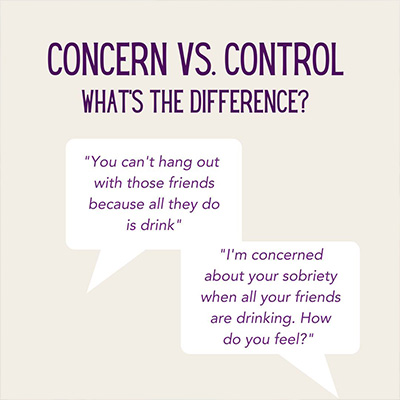
“I don’t want him hanging out with those friends because all they do is drink.” “Her family is terrible to her, so I don’t want her to have contact with them.” “I’m only trying to help them be better.”
While these sentiments may appear to be rooted in concern, the true intention is to control their partner’s actions.
“You can’t tell your partner who they can and cannot spend time with,” says Mary Jane McCarthy, a counselor at JBWS’ Jersey Center for Non-Violence. “But you can express your concern for your partner’s safety or your feelings about their behavior.”
For instance, if your partner is close friends with people who make you feel insecure or jealous, then you can express that concern to your partner. However, you cannot force them to abandon those relationships because of your feelings.
“You have every right to tell your partner how their behavior makes you feel but, at the end of the day, every person has the right to spend time with whoever they choose,” says Mary Jane. “In this situation, the only thing you have control over is yourself.”
This can be a difficult notion to grasp, particularly if you find comfort in controlling your environment. However, all you can control is whether you want to remain in a relationship with that person.
“There are always compromises in any relationship, but you can’t expect a person to give up core pieces of their identity,” explains Mary Jane. “You have to ask yourself: ‘Do I really want a person to fundamentally change who they are just to be with me?’”
If the answer is yes, then it’s important to reflect on where this need for control stems and consider what function it is serving. For example, a person insisting that their partner cannot hang out with other people may have a fear of abandonment.
While that fear may be their motivation, it is never an excuse to control another person’s actions. No person has the right to be controlled by someone else.
“If it makes you uncomfortable that your partner is friends with a lot of attractive people, then you can choose to not be in a relationship with them, but you cannot force them to stop seeing their friends,” adds Mary Jane. “Boundaries are about YOU, not the other person, it’s about what you need to do for yourself. If a boundary is forced upon another person, it’s not a boundary at all – it’s a demand.”
If you notice these behaviors in your partner, please call JBWS’ 24-Hour Helpline: 1.877.782.2873
If you notice these behaviors in yourself, JBWS can help: jbws.org/jcnv or 973-539-7801